1.800.221.5175
Catechetical Programs
Christ In Us Grades K–8
Parish, K–8
School, K–8
Bilingual, K–6
We Believe: Living Your Catholic Identity Grades K–8
Parish
School
Full Access
Bilingual, K–6
Bilingual, 7–8
One Faith, One Lord Grades 7–Adult
English
Bilingual
Our Catholic Faith Grades 4–6
English
Bilingual
God’s Own Making
Grades 4-8
We Believe: Discovering God
PreK/Ages 3–5
Between You and Your Child
English
Spanish
Catechetical Bilingual
Creemos: Descubriendo a Dios
Edades 3–5
Creemos Identidad católica
Cursos K–6
Cristo en nosotros
Cursos 1–6
Vivimos nuestra fe
Cursos 7–8
Nuestra fe católica
Cursos 4–6
Una sola fe, un solo Señor
Cursos 7–Adulto
Entre usted y sus hijos
Cursos K–8
Sacraments Programs
Believe • Celebrate • Live | Bilingual Edition Ages 7–15
Reconciliation Primary
Eucharist Primary
Reconciliation & Eucharist Intermediate
Confirmation Restored Order
Confirmation
We Believe and Celebrate
Baptism
Spanish Edition
Prayer Books
My Reconciliation and Prayer Book, Ages 7–9
Mi Reconciliación y libro de oración, Edades 7–9
My Mass Book, Ages 7–9
Mi libro de la Misa, Edades 7–9
We Believe and Pray, Grades 4–6
Sacraments Bilingual
Creer • Celebrar • Vivir Edades 7–15
Reconciliación Primaria
Eucaristía Primaria
Reconciliación y Eucaristía Intermedio
Confirmación Restauración del orden sacramental
Confirmación
Creemos y celebramos
Bautismo
Libros de oración
Mi Reconciliación y libro de oración, Edades 7–9
Mi libro de la Misa, Edades 7–9
Lifelong Faith
Bible Resources
The Compass Bible for Catholic Teens
YOUCAT: Youth Catechism of the Catholic Church
YOUCAT: Catecismo Joven de la Iglesia Católica
La Biblia católica para jóvenes
Adult Resources
Becoming a Parish of Mercy
Catechism
United States Catholic Catechism for Adults
General Directory for Catechesis
Professional Development
Catechetical Learning
Theology of the Body Course
Catholic Identity Course
Resources
English | View All
Catechetical Resources
Virtual Events
Religion Blog
Catechetical Downloads
Videos
Liturgical Seasons
CHATechesis Podcast
Bilingual | ver todos
Recursos catequéticos
Eventos Virtuales
Blog de Sadlier Religion
Descargas Catequéticas
Videos
sadlierReligion Hero-1.png

April 6, 2026 REL Topic - Catechesis, REL Topic- Saints, REL PD - Catechist, REL PD - Leaders

Six African American Catholics on the Path to Sainthood

The Catholic Church is shaped by faithful witnesses from every culture, and African American Catholics have left an enduring mark through lives of service, courage, and holiness. Many of these men and women lived during times of slavery, racism, and social injustice, yet they remained steadfast in their faith and dedicated themselves to helping others. Their contributions include founding schools, religious communities, and charitable initiatives that strengthened Catholic communities and brought hope to the marginalized. By learning their stories, we see how holiness can grow in everyday actions through generosity, prayer, and perseverance. These remarkable individuals are now on the Church’s path toward canonization, recognized for lives that inspired others and reflected Christ’s love. Their examples invite Catholics of all ages to live faith boldly and serve others with compassion and courage. This article features six African American sainthood candidates and their inspiring stories.

Sadlier Religion Blog Title Image_Six African American Catholics


Venerable Pierre Toussaint (1776–1853)

Pierre Toussaint was born into slavery in Haiti on June 27, 1766. He and his family lived on a plantation owned by the Berard family. 1n 1797, the Berard family took Pierre and his sister, Rosalie, with them when they moved to New York City. Upon arriving in New York, Pierre apprenticed with a leading hairdresser and went on to become a successful hairdresser in his own right. Mr. Berard returned to Haiti to take on some business and died of pleurisy. Mrs. Berard remarried in New York and freed Pierre on her deathbed in 1807. Pierre married a slave woman, Juliette Noel, in 1811, after he had purchased her freedom. They adopted two children who had been orphaned in Haiti. Together they began a career of charity among people experiencing poverty in New York City. Pierre attended daily Mass for 66 years at St. Peter’s in New York. He and his wife sheltered orphans and fostered numerous boys. They also organized a credit bureau, an employment agency, and a refuge for needy travelers. Pierre raised money for Old St. Patrick’s Cathedral on Mulberry Street. He was also a benefactor of the first Catholic school for black children in New York City at St. Vincent de Paul on Canal Street.

African American Catholics Cultural Connection Kit

Engage Catholic kids and families with stories and symbols from African American Catholic heritage. This kit for home or classroom use connects faith and culture, introduces the “Saintly Seven” and includes music, art, and prayer.

REL_DL_AfricanAmericanCatholicsCulturalConnection_Kit_@2X

Download Now


Pierre’s wife Juliette died in 1851 Pierre died on June 30, 1853. They were both buried in the cemetery of Old St. Patrick’s Cathedral. John Cardinal O’Connor, Archbishop of New York, opened Pierre’s cause for canonization in 1968. Pierre’ body was exhumed and examined as part of the process. He was then reinterred in the present-day St. Patrick’s Cathedral, and he is the only layman to be honored by burial in the crypt below the main altar at St. Patrick’s Cathedral. In 1997, Pierre Toussaint was declared venerable by Pope John Paul II.

Venerable Mother Mary Lange (1784–1882)

Mary Elizabeth (born Elizabeth Clarisse) Lange was born in Haiti in 1784. During the Haitian Revolution, her parents escaped and took the family to Cuba, settling in Santiago de Cuba. She left Cuba in the early 1800s and immigrated to the United States. She landed in Charleston, South Carolina, and later moved to Norfolk, Virginia. She moved to Baltimore sometime in the 1820s where there was a large population of free people of color, many of whom were from Haiti. After arriving in Baltimore, she settled in the Fells Point area in Baltimore.

In 1818, Mother Lange opened a school for girls in her home. It is now called St. Francis Academy. The school eventually became a coed school. Up until the present day, St. Francis Academy is a flourishing school that is filled to capacity.

Mary Lange and a friend felt called to consecrate their lives to God, and with the help of a Sulpician priest, Fr. Joubert, they were able to get the approval of the Archbishop of Baltimore to found a new religious community—the Oblate Sisters of Providence. It was the first religious congregation for women of African descent in the United States. On July 2, 1829, Mary Lange and three other women took their first vows. In the midst of helping with poverty, racism and other hardships, the Oblate Sisters sought to evangelize the Black community through Catholic education.

Mother Mary Lange died on February 3, 1882. She was buried in the Cathedral Cemetery. In 1991, William Cardinal Keeler, Archbishop of Baltimore, opened her cause for canonization. In 2013, Mother Lange’s remains were exhumed and transferred to the Baltimore community of the Oblate Sisters, where she was reinterred in their chapel. Pope Francis declared her venerable on June 22, 2023.

Venerable Henriette Delille (1812–1862)

Henriette Delille was born in New Orleans on March 11, 1813. In 1836, Henriette founded a small, unrecognized congregation of religious sisters, which she named the Sisters of the Presentation. In 1837, the congregation secured recognition from the Holy See. Henriette took the position of superior general in the congregation. In 1842, the congregation changed their name to the Sisters of the Holy Family.

In a city marked by deep contrasts and complex histories, Delille and her sisters devoted themselves to caring for the poor and to educating African American children. Their work offered a beacon of hope and dignity that planted seeds of faith that would grow through generations and transform a divided society. By 1909, the congregation had 150 members, and by 1950 membership in the congregation peaked at 400. The sisters have operated schools, nursing homes and retirement homes in New Orleans and Shreveport in Louisiana; Washington, DC; Galveston, Texas; Little Rock, Arkansas; California; and in a mission in Belize.

Henriette Delille died on November 16, 1862. In 1988, her cause for canonization was opened by the Holy See—a first for an African American. Her cause was endorsed unanimously by the United States Conference of Catholic Bishops in 1997. Henriette Delille was declared venerable by Pope Benedict XVI on March 27, 2010.

Servant of God Julia Greeley (between 1833 and 1848–1918)

Julia Greeley was born into slavery in Hannibal, Missouri in the mid-19th century, At the age of five, her right eye was injured by a slave master as he whipped her mother. She became referred to as “one-eyed Julia.” Julia was not freed by the American Black Emancipation Proclamation, but rather by the Missouri emancipation in 1865.

After gaining her freedom, she moved to Denver, where, despite her own poverty, she devoted her life to helping those in need. In Colorado, she did the work typically done by an enslaved person—caring for children, cooking, cleaning houses, and so on. She loved children, but she was never married. Julia always helped everyone. She would go around and beg for things for other people using a little red wagon to carry the items that were given to her. Because she never wanted to embarrass anyone, she did all of her work in the dead of night. She became known as "Denver’s Angel of Charity.” Julia went to Mass every day. She also became a Secular Franciscan.

Julia Greeley died on June 17, 1918, and lay in repose in Sacred Heart Church’s Loyola Chapel— a first for a Catholic lay person that has not been repeated. Her cause for canonization was opened in 2016 by Archbishop Samuel Aquila, Archbishop of Denver. Her body was moved to Denver’s Cathedral Basilica of the Immaculate Conception in 2017.


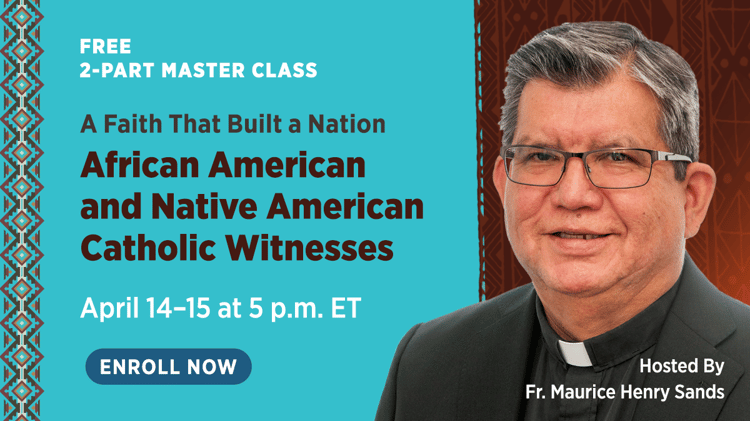
A Faith That Built a Nation: African American and Native American Catholic Witnesses Masterclass

Discover their inspiring stories of faith, service, and perseverance that shaped the Church in the United States.

01B_26_Masterclass_Sands_Apr_CathWitness_Email1_Invite_@2X_1R

Enroll Now


Venerable Augustus Tolton (1854-1897)

John Augustus Tolton was born into slavery just before the Civil War on April 1, 1854. His father escaped from his owners in order to join the Union army. Augustus’ mother escaped with her children in 1863 and settled in Quincy, Illinois. Augustus very badly wanted to become a priest, but he was rejected by every seminary to which he had applied. His bishop arranged for him to study at the Pontifical Urban University seminary in Rome, and he was ordained a priest in 1886. Originally expecting to serve as a missionary in Africa, he was assigned to the United States as a missionary to his fellow African Americans. He was assigned to serve in his hometown of Quincy in the Diocese of Alton—where he faced discrimination from both fellow Catholic priests and local black Protestant clergy. In 1889, he was able to transfer to the Archdiocese of Chicago where he was asked to spearhead the development and construction of St. Monica Church as an African- American “national parish” on Chicago’s South Side.

Augustus Tolton died on July 9, 1897. His cause for sainthood was opened by Francis Cardinal George on February 24, 2011. He was declared venerable by Pope Francis on June 12, 2019.

Servant of God Sr. Thea Bowman (1937-1990)

Thea Bowman was born in Yazoo City, Mississippi in 1937, and was raised in Canton. Originally a Methodist, she converted to Catholicism at the age of nine while attending Holy Child Jesus School in Canton. Her deep faith and passion for education led her to become the first African American member of the Franciscan Sisters of Perpetual Adoration at La Crosse, Wisconsin when she was fifteen. In 1965, she earned a B.A. in English at Viterbo University. She went on to study at the Catholic University of America, earning an M.A. in English in 1969 and a Ph.D. in English in 1972. She became a founding member of the National Black Sisters’ Conference in 1968. Sr. Thea taught at various elementary schools, colleges and universities. She was instrumental in the 1987 publication of a new Catholic Hymnal, Lead Me, Guide Me: The African American Catholic Hymnal. She was diagnosed with cancer in 1984. Just months before her death in 1989, Sr. Thea offered a powerful and moving address to the United States Conference of Bishops from her wheelchair.

Sr. Thea died on March 30, 1990 in Canton, Mississippi. She was buried with her parents in Memphis, Tennessee. Her cause for canonization was opened by the Diocese of Jackson in 2018.

Lessons from Their Lives: Inspiration for Today’s Catholics

The lives of these African American Catholics demonstrate that holiness is found in faithful service, perseverance through hardship, and unwavering trust in God. Whether through education, charity, pastoral ministry, or evangelization, they transformed their communities and set enduring examples of faith in action. Their journeys toward sainthood show that every member of the Church—laypeople and religious alike—can answer God’s call in extraordinary ways. Learning about their witness encourages families, students, and educators to reflect on how their own actions can embody faith and compassion. As the Church continues to discern their causes, these lives remain a source of inspiration for all Catholics today. They remind us that lives lived with courage and love can leave a lasting impact on the world.