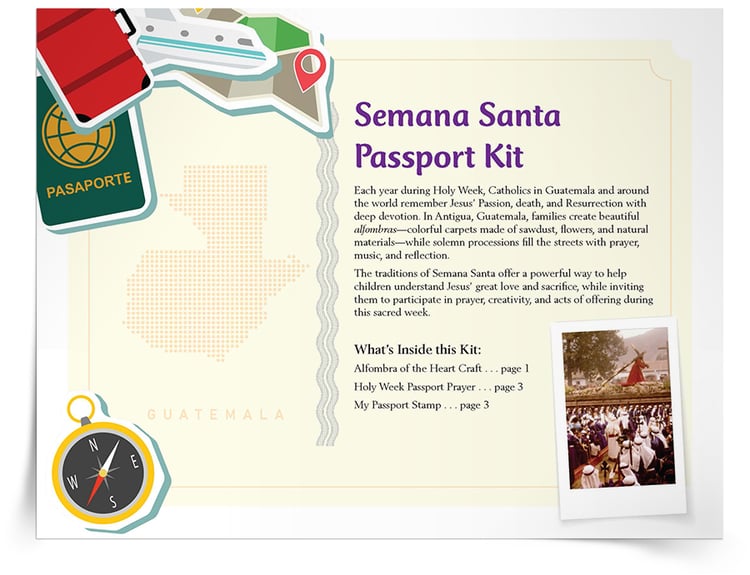
Each year during Holy Week, Catholics around the world turn their hearts toward the final days of Jesus’ earthly life to his Passion. In Guatemala, this sacred story unfolds beyond churches and in the streets, where faith is expressed through color, craftsmanship, procession, and communal devotion.

As part of our ongoing journey through Catholic cultural celebrations, this Holy Week tradition invites families and children to encounter the Passion of Christ in a vivid way. Don’t forget your My Catholic Passport as you follow each celebration; add a new stamp for every destination you “visit” here on the Sadlier Religion blog. After exploring earlier celebrations across the global Church, our next destination brings us to Antigua, Guatemala where Semana Santa becomes a powerful witness to love, sacrifice, and Catholic identity.
Semana Santa in Guatemala brings the story of Jesus’ Passion to life through vivid sights, sounds, and traditions. For children, these experiences make Holy Week tangible, helping them see, feel, and remember Christ’s love in a deeply meaningful way. Through processions, prayer, and symbolic art, families can enter more fully into the Holy Week and Easter.
Holy Week—known as Semana Santa—is the most sacred time in the Catholic liturgical year. Across the globe, Catholics prayerfully remember the Passion, death, and Resurrection of Jesus Christ. In Guatemala’s historic city of Antigua, these days unfold with a unique intensity that engages the whole person. Visitors come from around the world to experience it.
Cobblestone streets become pathways of prayer. Churches open their doors to thousands. Entire communities participate in traditions that have been passed down for generations. Here, faith can be seen, heard, carried, and even walked upon.
For Catholic families and catechists, Semana Santa in Guatemala showcases a powerful model of how to make the Holy Week accessible and memorable.
In Antigua, one of the most well-known centers of Holy Week observance, the days from Palm Sunday through Easter Sunday are marked by continuous acts of devotion. These events invite a unified expression of communal faith rooted in Catholic tradition and local culture.
At the heart of these observances are processions that move slowly through the streets. Large wooden platforms—called andas—carry sacred images depicting scenes from Christ’s Passion: Jesus carrying the cross, the crucifixion, and the sorrow of the Blessed Mother. These platforms are borne on the shoulders of men and women, for long distances and durations, as an act of prayer and sacrifice.
It is beneath these processions that lie one of the most recognizable features of Guatemalan Semana Santa: alfombras, or sawdust carpets. In Spanish, alfombra means “carpet.” These works of art are made from colored sawdust, flowers, pine needles, and even other natural materials like fruit, these intricate designs transform the streets into temporary works of sacred art.
Families, neighbors, and artists work together—often through the night—to complete these carpets before the processions begin. Yet their beauty is fleeting. As the procession passes, the images are walked upon and quickly disappear, reminding all who witness them of the humility, sacrifice, and impermanence at the heart of the Christian life.
The largest processions take place on Good Friday. Incense fills the air as mournful music echoes through the streets. Silence and reverence guide the crowds as they accompany Christ on his journey to the Cross.
One of the most powerful aspects of Semana Santa in Guatemala is how it teaches the faith through a sensory experience. Participants:
Semana Santa remembers past events while also bearing a living witness of Catholic identity. For Guatemalan Catholics, the week is a communal act of faith. Entire neighborhoods collaborate to prepare altars, design alfombras, and participate in processions. This shared effort reflects the reality that the Church is not simply a place we go, but a community of people we belong to, teaching children and families:
Semana Santa also serves as a quiet yet powerful form of evangelization. Visitors from around the world come to witness these traditions, often encountering the depth and beauty of the Catholic faith for the first time.
The celebration of Semana Santa in Guatemala is another beautiful reminder that the Catholic Church is universal, embracing diverse cultures while proclaiming one unchanging truth.
In Guatemala, the Gospel is expressed through color, artistry, and communal devotion. Semana Santa reminds us that faith takes root in every culture it touches. For families and catechists, this is an important reminder. Teaching the faith to children includes helping them experience the beauty and meaning of those truths in ways they can see, hear, and feel.
Semana Santa invites us to consider:
You don’t need to travel to Guatemala to share the richness of these traditions. With simple adaptations, you can help children enter Holy Week in meaningful and memorable ways.
Invite children to design their own small “carpet” using the printable activity in the Semana Santa Passport Kit. Provide materials such as colored salt or rice, flower petals, or paper cutouts.
Guide children through the Stations of the Cross with a simple journal activity. This practice helps children reflect more personally on Christ’s journey and builds a habit of prayerful meditation.
Encourage families to light a candle each evening of Holy Week and pray together. Reflect briefly on where Jesus is in the story—from the Last Supper to the Resurrection—and offer simple intentions.
Use age-appropriate Gospel readings, books, or videos to tell the story of Jesus’ Passion and Resurrection. Repetition and storytelling help children internalize the meaning of these sacred days.
Semana Santa in Guatemala stands as a breathtaking witness to the beauty, depth, and universality of the Catholic faith. Through its vibrant colors, solemn processions, and communal devotion, it brings the story of Christ’s Passion into the present moment for all Catholics to experience.
For Catholic families and catechists, the invitation is not to replicate the grandeur of Guatemala, but to embrace its spirit. Holy Week is a journey that invites us to consider that each of our lives, offered with love, are a beautiful gift for God.