Processions that Inspire Faith and Celebration
What Is Corpus Christi in Poland?
Corpus Christi (Boże Ciało) is one of the most important Catholic feasts in Poland. It is celebrated on the Thursday after Trinity Sunday. Trinity Sunday is celebrated the Sunday after Pentecost and usually falls in early to mid-June.
While the feast is universal in the Church, Poland observes it as a national public holiday with deep cultural significance. Most cities, towns, and even small villages hold elaborate Eucharistic processions that move from the church through the streets, stopping at outdoor altars for readings, songs, and benediction.
Key Features of the Celebration
- Public procession led by priests carrying the Blessed Sacrament in a monstrance
- Children in white clothing, especially First Communicants, scattering flower petals
- Four outdoor altars representing the four Gospels
- Traditional hymns and prayers sung throughout the streets
- Streets decorated with greenery, flowers, and religious banners
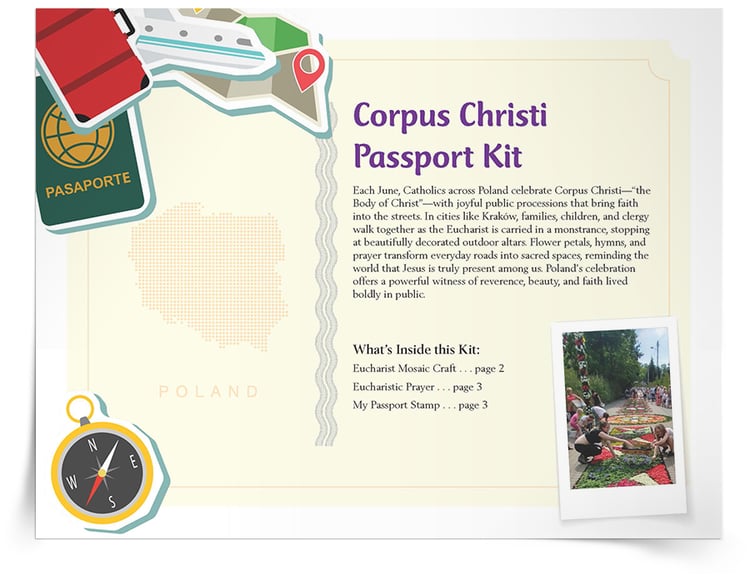
Corpus Christi Passport Kit
Help children and families learn about the Polish celebration of Corpus Christi and honor the real presence of Jesus Christ in the Eucharist through art and prayer. Plus get the collectable passport stamp from Poland.


What Corpus Christi Means for Catholics
Corpus Christi is a feast born from deep reverence for the real presence of Jesus in the Eucharist. It was instituted in the 13th century after a series of Eucharistic miracles and papal encouragement, and it remains a bold public proclamation of faith.
In Poland, the celebration takes on an added layer of cultural identity:
- During times of political oppression, these processions were acts of quiet resistance.
- For many, it remains a source of national and spiritual pride—faith is part of the public square.
For Catholic children, the feast of Corpus Christi:
- Reinforces the sacredness of the Eucharist
- Shows that faith is not just private—it can be celebrated joyfully and publicly
- Connects them to the global Church’s ancient tradition of honoring Christ in the Eucharist
The Global and Universal Message of Corpus Christi
Polish celebrations of Corpus Christi offer a powerful witness to the world about the Eucharist’s central place in Catholic life. For the universal Church, this feast affirms:
- The Eucharist is not only a personal devotion—it is the source and summit of Christian life (CCC, 1324).
- Public witness to our faith—like Eucharistic processions—are vital in today’s world.
- Reverence and beauty in liturgy and devotion form young hearts in awe and love for Jesus.
This celebration invites us all to pause and remember that the same Jesus who walked the roads of Galilee now walks with us in the form of bread consecrated and adored.
Celebrating Corpus Christi with Catholic Kids
Whether you’re a catechist or parent, there are many ways to teach children about the feast of Corpus Christi at home or in the religious education classroom.
Teach with the Monstrance
Explain that the monstrance is like a throne that displays Jesus, truly present in the Eucharist. Let kids draw or color a monstrance with rays showing Jesus' light going out into the world.
Make Petal Paths
In Poland, children scatter flower petals before the Blessed Sacrament. Invite children to make a “flower path” collage—gluing tissue paper or dried flower petals on a construction paper road leading to a church.
Host a Mini Procession
In your home or classroom, create a simple procession:
- Use a small cross or image of the Eucharist.
- Walk slowly to four “stations” where you read Scripture or say a prayer.
- End with a song like “Jesus, My Lord, My God, My All.”
Storytime
Share the story of St. Juliana of Liège, the saint who promoted this feast. Let children reflect on how Jesus used her love and courage to give the Church a special way to honor the Eucharist.
Bringing the Joy of Corpus Christi into Everyday Life
Poland’s vibrant and faithful celebration of this feast invites Catholic families and children to bring their love for Jesus into the public square. Whether through a craft, a lesson, or a simple procession in your backyard, this June feast is a powerful way to pass on Eucharistic wonder to the next generation.