Catholic missionary work in North America unfolded over centuries and across diverse regions, cultures, and historical circumstances. This article traces the early spread of Christianity among Native peoples, beginning with Spanish Franciscan missionaries in the Southwest, followed by French Jesuit missions in the North, the life and witness of St. Kateri Tekakwitha, continued missionary expansion during the 1800s, and the ongoing role of the Bureau of Catholic Indian Missions. Together, these accounts highlight the faith, sacrifice, and complexity that shaped the Catholic presence among Indigenous communities in what is now the United States.

The encounter between Christianity and the tribes of North America is a story woven with threads of complexity. It is a narrative marked by the crossing of worlds, where spiritual discovery walked hand in hand with the imperialistic impulses of empires.
The Spanish were the first to encounter the indigenous peoples of North America. By the early 1500s, Spanish missionaries had reached the southwestern United States, beginning a profound spiritual engagement with the Native peoples of that region.
Prior to the arrival of Europeans, the part of the Southwest that is now New Mexico was inhabited primarily by what we now refer to as the Pueblo Tribes. They were living in the Rio Grande Valley from the north of New Mexico all the way down to El Paso. The Navajo settled in the Southwest about 700, 800 years ago. A couple of hundred years before the Spanish arrived.
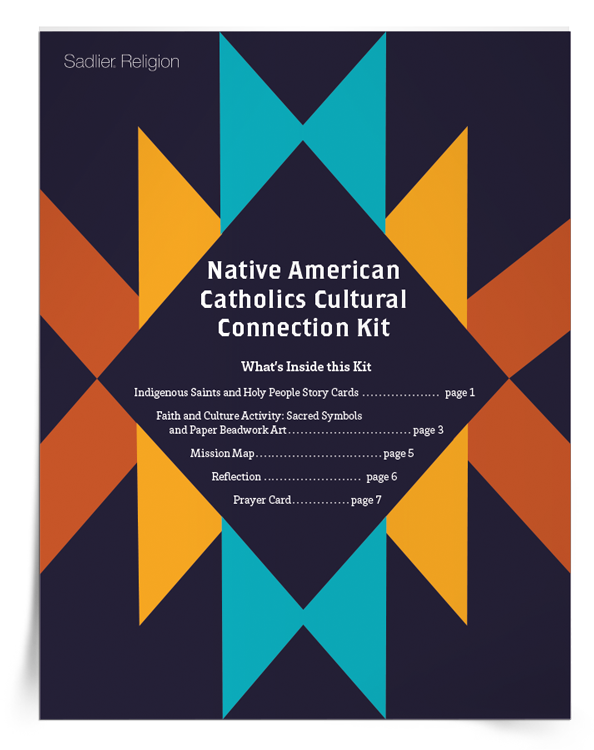
Help Catholic kids and families explore how faith is lived in Native American communities—through saints, symbols, prayer, and creative reflection. This ready-to-use, printable kit brings the richness of Indigenous Catholic faith into classrooms, parish programs, and homes, guiding children to recognize holiness in diverse communities, understand how faith and culture work together, see Catholicism as both universal and local, and reflect through prayer.
The earliest missionary work in the Southwest was primarily conducted by the Franciscan order, The Franciscan Order, had literally millions of baptisms coming primarily through the influence of Our Lady of Guadalupe, … so the Franciscans continued their missionary effort further north, extending into what is now the United States. The friars often went on foot. They were anxious and zealous for the Word of God. They went unarmed to many places that even at times, the soldiers would not go to. They went unaccompanied by any kind of military guard and showed tremendous courage in doing that.
As the Spanish continued their missionary efforts in the southwestern United States, another chapter was unfolding in the north. In the early 17th century, French missionaries, driven by a profound dedication to spread Christianity, ventured into what is now Canada and the northern regions of the United States. These Jesuit priests, known as the "Black Robes" for their distinctive attire, embarked on a mission not only to evangelize but to understand and respect the cultures they encountered.
Jesuits priests, Fr. Pierre Biard and three Jesuit companions founded Saint-Sauveur, the first mission in Maine, in 1613. The mission was established to serve members of the Abenaki tribe.
In 1619, the Recollet Franciscans opened a mission in modern-day Nova Scotia and New Brunswick. The Sulpician Father Dollier de Casson celebrated Mass at Fort Ste. Anne on Isle La Motte in Vermont in 1666. 1n 1710, the Jesuit missions at Swanton and Ferrisburg were opened.
In 1640, Jesuits St. Isaac Jogues and Fr. Charles Raymbault visited the area called Sault Ste. Marie in Michigan and planted a cross on the St. Mary’s River. Jesuit Rene Menard established a mission at Keweenaw Bay in 1660. Jesuit Fr. Jacques Marquette established the mission at Sault Ste. Marie in 1668, and Jesuit Fr. Claude Dablon founded St. Ignace Mission in 1669.
A mission was established by the Jesuits in Green Bay, Wisconsin in 1636. By 1670, the Jesuit Fr. Claude Allouez, aided by other Jesuit Fathers, had established 20 missions in the area.
Jesuits established the first mission among the Dakota Sioux near Hastings in Minnesota in 1655. In 1727, Jesuits erected St. Michael the Archangel for the Sioux on Lake Pepin. In 1732, Jesuit Fr. Charles Messaiger founded St. Charles Mission near Lake in the Woods. In the 1800’s, Minnesota’s Catholic missions thrived under the direction of the Jesuits and Benedictines.
We know a lot about the life of St. Kateri thanks to the Jesuit Relations, which contain the writings of several Jesuit fathers who observed her life as a Christian and of others who recorded the events of their own missionary efforts.
During the time that St. Kateri lived, several groups of people collided and shifted with one another: the Iroquois, the Dutch, the British, the French, and the Kingdom of God. Their interactions resulted in many changes in their cultures, religions, politics and territorial possessions. In the 1600’s, prior to Kateri's birth, the Jesuits had made many converts among the Algonquins and the Hurons and were beginning to try to reach out to the Mohawks.
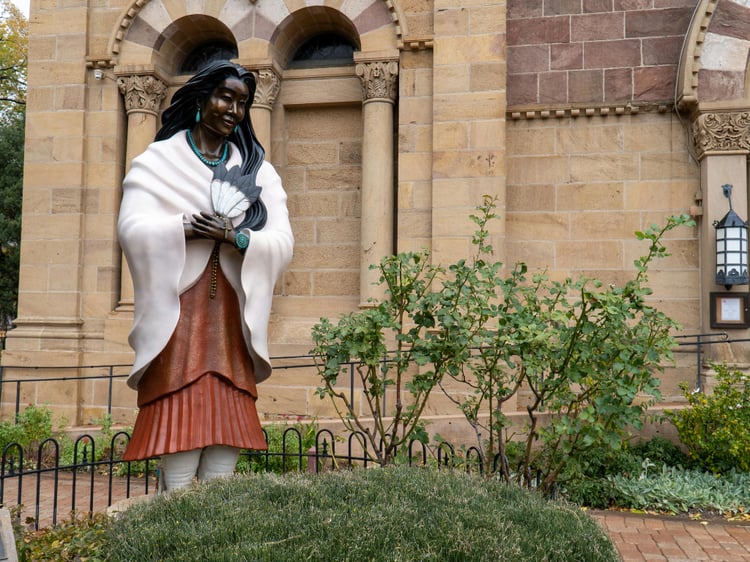
St. Kateri was born in 1656 in the Mohawk village of Ossernenon to a Mohawk chief and Christian Algonquin mother. When she was four years old, her parents and infant brother died of smallpox, and that she survived the disease left with permanent scarring, very poor vision and a weakened body. She was adopted by her father’s brother. He was also a chief. In 1666, the French attacked and destroyed several Mohawk villages, including the village where St. Kateri lived. Afterwards, the Mohawks made peace with the French and agreed to allow the Jesuits to establish missions in their communities. St. Kateri's first encounter with Jesuit missionaries took place in 1667. During her middle to later teen years, her family wanted her to marry, but St. Kateri wanted to become Catholic and dedicate herself to Christ. A Jesuit priest, Fr. Lamberville, arrived in her community in 1674, and he baptized her on Easter Sunday in 1676. He gave her the baptismal name of Catherine, after St. Catherine of Siena. Her family and community members harassed her because she had become a Catholic, so she left her home in the fall of 1676 to go to the Mohawk community of Kahnawake—across the river from Montreal. During the remaining four years of her life, Kateri lived a life of heroic virtue in the Catholic Mohawk community of Kahnawake. She made a profession of perpetual virginity on the feast of the Assumption: March 25, 1679. St. Kateri died during Holy Week on April 17, 1680.
St. Kateri was known for having an unwavering faith in Jesus—an active and lively faith that impacted every aspect of her life from the moment when she first heard the Gospel until the day of her death. Her faith was expressed through her many acts of devotion to Christ and her many acts of kindness to others.

1887 – Jesuits entered Alaska missions: Holy Cross Mission for Ingalik, Eskimo mission at Akulark, and Nulato mission at Koyuku. Ursuline Sisters began serving at St. Michael’s for Inuits and at Valdez. Sisters of St. Anne began to serve in Juneau.
Arizona
1864 – School opened at San Xavier del Bac Mission
1869 – Sisters of Loreto began serving at Arizona missions
1898 – Franciscan Fr. Bernard Haile began serving the Navajos
1902 – St. Michael’s Mission and School opened with support of St. Katharine Drexel and the Sisters of the Blessed Sacrament
California
1817 – Franciscans established San Rafael Arcangel Mission
1823 – Franciscans established Mission San Francisco de Solano
1870 – Fr. Luciano Osuna established St. Turibius Mission near modern Kelseyville
Idaho
1840 – Jesuit Fathers Pierre Jean De Smet and Nicholas Point established Sacred Heart Mission for the Coeur D’Alene tribe in northern Idaho
1867 – Jesuit Fr. Joseph Cataldo began fifty years of missions among the Nez Percé and Slickapoo tribes
Kansas
1839 – Jesuit Fr. Christian Hoecken established Potawatomi mission at Sugar Creek
1840 – St. Rose Philippine Duchesne founded Sacred Heart convent and school at Sugar Creek
Michigan
1830 – Fr. Frederick Baraga began mission to the Ottawa Indians and established missions in various places in Michigan – L’Arbe Croche, Grand Rapids, Keweenaw Bay, L’Anse, ….
Minnesota
>1878 – Benedictines open Crookston, White Earth, and Red Lake missions
Montana
1821 – Flathead and Nez Percé tribal members go to St. Louis, MO seeking missionaries
1841 – Jesuit Fr. Piere Jean De Smet opened St. Mary’s Mission on Bitter Root River
1846 – Jesuit Fr. Nicholas Point began to serve the Blackfeet at St. Peter’s
1884 – Fr. Joseph Eyler opened St. Labre Mission for the Northern Cheyenne
1890 – nine missions and stations were operating, with nine Indian schools, assisted by the Sisters of Providence and Ursuline Sisters
New Mexico
1894 – St. Katharine Drexel opened St. Catherine’s school for the Pueblo Indians
1899 – Archbishop Bourgade invited Franciscan Sisters of Lafayette to open mission schools at Jemez, Peña Blanca, San Fidel, Cuba and Gallup
North Dakota
1821 – Jesuit Fr. George Belcourt opened St. Joseph Mission at Walhalla
1877 – Standing Rock Mission opened by the Benedictines Oregon
1844 – Jesuit Fr. Jean Pierre De Smet founded St. Francis Xavier Mission near St. Paul
1847 – St. Andrew’s Mission founded at Pendleton
South Dakota
1878 – Benedictines opened school at Fort Yates on the Standing Rock Reservation
1886 – Jesuits began serving at St. Francis Mission on the Rosebud Reservation
1888 – Jesuits began serving at Holy Rosary Mission on the Pine Ridge Reservation
Washington
1844 – Jesuit Fr De Smet founded St. Paul Mission at Colville
1884 – Oblate Fathers Eugene Casimir Chirouse and Charles Pandosy began serving at St. Rose Mission in Yakima
1858 – Tulalip School opened for the Swinomish
1860 – Tulalip mission established to serve the Snohomish, Swinomish, Lummi and Duwamish tribes
Wisconsin
1854 – Missions established at Menominee, Nett Lake, Fond du Lac, New Ulm and other sites
The Bureau of Catholic Indian Missions was established in Washington, DC 1874 to be advocate for Native American and Alaska Native Catholics in their relationships with the Catholic Church and the Federal Government of the United States. The Catholic bishops of the United States, at their Third Plenary council in Baltimore in 1884, established the first national collection in the United States to raise funds to support ministry to African American and Native American Catholics. To the present day, funds from the collection are given to parishes, missions, schools, dioceses and national organizations to help with the following ministerial needs of Native American Catholics: stipends and salaries for priests, religious brothers and sisters, and lay personnel; evangelization programs; religious education and faith formation programs; retreats; conferences; Catholic school tuition assistance; Catholic school teachers salaries; rural parish subsidies, and more.
Dive into the stories of Native American and African American Catholic witnesses with a free, on-demand masterclass that explores saints, history, and faith shaping a nation. Register now to access both sessions and earn a certificate of participation.
The history of Native American Catholics in North America is a story shaped by faith, perseverance, and complex cultural encounters. From the early Spanish Franciscan missionaries who traveled unarmed into the Southwest, to the French Jesuits who established missions across the Northeast, Great Lakes, and Plains, Catholic evangelization unfolded across vast geographies and generations.
The history of Native American Catholics in North America is a story shaped by faith, perseverance, and complex cultural encounters.
The life of St. Kateri Tekakwitha stands as a powerful witness to Indigenous faith, showing how the Gospel took root within Native communities through personal conviction, sacrifice, and holiness. As missionary efforts continued into the 19th century and beyond, religious orders, clergy, and lay leaders established missions, schools, and parishes that remain part of Native Catholic life today. The ongoing work of the Bureau of Catholic Indian Missions reflects this enduring commitment—supporting Native American and Alaska Native Catholics as they continue to live and express their faith within their own cultures and communities.